

Enterprise Cross-Border Settlement: The Real Architecture (Not Crypto Replacement)
How hybrid DLT + smart contracts orchestrate atomic settlement without replacing legacy banking

Most people think blockchain will replace traditional payment rails.
It won’t.
The real breakthrough isn’t rip-and-replace. It’s interoperability at scale—using distributed ledger technology to orchestrate, not disrupt, the legacy infrastructure that moves trillions daily.
This is the architecture that’s already being built. Not in crypto. In enterprise finance.
The Misconception: Why “Blockchain Kills SWIFT” Never Happens
For fifteen years, fintech evangelists have promised that blockchain would:
Replace SWIFT messaging
Eliminate correspondent banking
Make settlement instant and cost-free
Remove the need for central banks
None of this happened. Here’s why: Legacy infrastructure doesn’t disappear because it’s embedded in regulation, risk management, and operational reality.
When JPMorgan moves $6 trillion in daily settlement through Fedwire, they’re not just moving money. They’re operating within:
Federal Reserve controls and monetary policy hooks
Liquidity coverage ratios (LCR) and capital requirements
AML/KYC screening at multiple checkpoints
Finality guarantees that come from state backing
You can’t replace that with code. You have to work with it.
The institutions trying to “disrupt” payments didn’t understand this. The institutions building the future do.
The Actual Architecture: Hybrid DLT Integration with Legacy Banking
Here’s what enterprise cross-border settlement actually looks like:
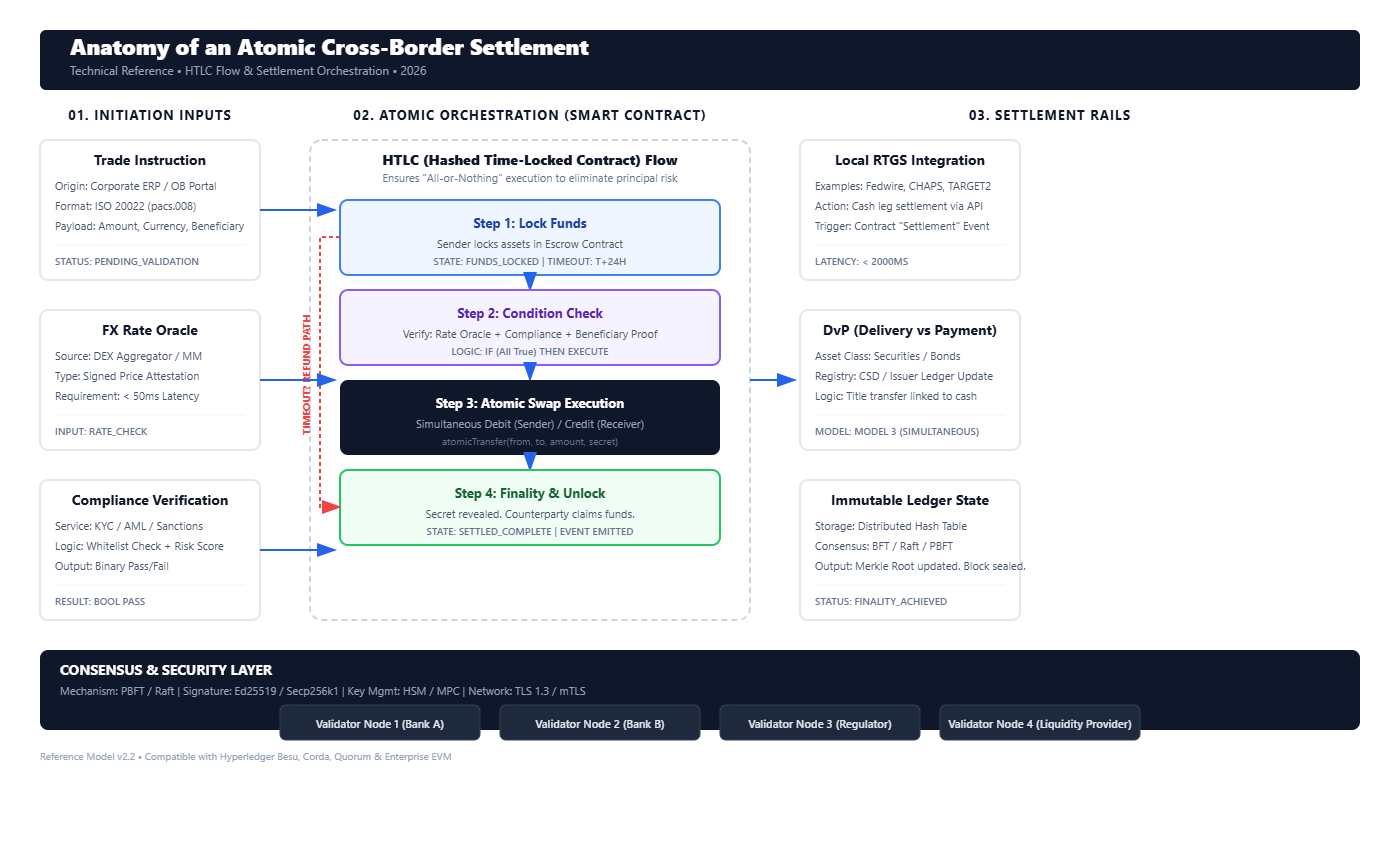
Layer 1: Channel & Access (API Gateway)
The entry point. Banks don’t connect to blockchain directly. They connect through standardized APIs built on ISO 20022 messaging standards—the same standard that runs SWIFT, but with structured data.
OB Portal / API: Trade initiation, document upload, real-time status tracking
Network Gateway: ISO 20022 & SWIFT message routing
BB Portal / API: Instruction receipt and status tracking for beneficiary banks
Corporate Portal: Real-time settlement visibility for importers/exporters
Regulatory Portal: Read-only compliance view and audit trails
The key insight: Blockchain never touches the API layer. It sits underneath, orchestrating what happens after instruction is received.
Layer 2: Business Logic & Application Orchestration
Where the processing happens. This is where traditional banking operations get coordinated, not replaced.
Six core functions run here:
Trade Data Capture & Validation — KYC/AML screening, sanctions checks
Sanctions & Compliance Screening — Real-time screening against SDN, OFAC, UNSC lists
FX Quotation & Pricing — Dynamic pricing based on market conditions
Settlement Instruction Creation — Atomic settlement terms are defined
Exception Management — Human intervention only when contracts can’t auto-execute
Status & Notification Service — Real-time visibility for all parties
Shared services across the network:
IAM & Access Control — Identity and permissions management
Audit & Logging — Immutable record of all actions
Configuration Management — Dynamic settlement term updates
Monitoring — Network health, performance metrics
This layer is where consensus logic begins—but it’s not consensus about who owns what. It’s consensus about what’s supposed to happen next.
Layer 3: Distributed Ledger & Blockchain/Consensus
Where finality actually lives. This is the difference between a ledger system and a blockchain system.
The Permissioned Network
A consortium blockchain (think Hyperledger Fabric, not Bitcoin) runs the core settlement logic:
Smart Contracts Enforce Atomic Settlement:
Network Access (OB Node) — Originating bank’s participant node
Smart Contract Factory — Generates settlement contracts dynamically
PvP Contract (Payment vs. Payment) — Cash and securities settle atomically
DvP Contract (Delivery vs. Payment) — Goods and cash settle atomically
Escrow Contract — Holds funds until conditions are met
Compliance & Fee Contract — Automates fee deduction and compliance checks
Distributed Ledger Infrastructure — Shared state machine (BB Node)
Network Access (BB Node) — Beneficiary bank’s participant node
Consensus Mechanism: The network uses BFT (Byzantine Fault Tolerant) consensus—typically PBFT, RAFT, or Istanbul BFT. But here’s what consensus actually means:
It doesn’t mean “miners validate.” It means “All participating banks agree on the current state before moving to the next state.”
A transaction flows like this:
Originating bank proposes a settlement instruction
Network nodes validate the instruction (funds available? compliance passed? all conditions met?)
Consensus reached when 2/3+ of nodes agree
Transaction committed to all ledgers simultaneously
Finality achieved in milliseconds
No forks. No probabilistic finality. No “we think it settled.”
Consensus Mechanism: BFT + Raft + BFT:
BFT (Byzantine Fault Tolerant) — Handles malicious or faulty nodes
RAFT — Leader election for block production
BFT — Final commitment across the network
This is why settlement goes from “T+2 or T+3” to “settlement in minutes.”
Layer 4: External Systems & Legacy Integration
The connector layer. This is where the permissioned ledger talks to the real world.
Core Banking Systems (Temenos, Finacle, TCS)—ledger-as-a-source-of-truth
RTGS Systems (Fedwire, CHAPS, TARGET2, CHIPS) — Final settlement in central bank money
ISO 20022 Gateways — Message translation and routing
KYC / AML Providers — Continuous screening
FX Liquidity Systems — Real-time market data integration
Here’s the critical point: The distributed ledger doesn’t replace RTGS. It orchestrates it.
When a PvP settlement contract executes:
Smart contract confirms both sides are ready
Settlement instruction is sent to RTGS system
Central bank confirms atomic settlement in Fedwire/TARGET2
Final confirmation written to distributed ledger
All parties see the same finality simultaneously
Atomicity without replacing central bank settlement. That’s the innovation.
Layer 5: Infrastructure & Security
The foundation. Where trust is enforced through cryptography, not custody.
Permissioned Network — Consortium membership (banks only, pre-approved)
Validator Nodes — Run by banks and clearing houses
HSM / Key Management — Hardware security modules for digital signatures
Network Security — TLS 1.3, VPN, Firewall
Monitoring — Prometheus, Grafana for real-time alerting
Disaster Recovery — Hot backup, failover, backup & restore
Every participant has cryptographic proof of what happened, but no one has unilateral custody of the assets.
The Transaction Flow: 12 Steps to Settlement
Here’s how a cross-border trade actually settles with this architecture:
Step 1: Trade Initiation Originating bank (OB) receives instructions from the exporter. System validates the trade: goods, amount, payment terms, beneficiary details.
Step 2: KYC/AML Compliance Screening System runs real-time screening against:
OFAC SDN list
UN sanctions committees
PEP databases
Transaction pattern analysis
Risk scoring
If any flag appears, exception management routes to human review. Settlement doesn’t proceed until cleared.
Step 3: ISO 20022 Message Formatting Trade instruction is formatted as a structured ISO 20022 message. This is critical—it means the system has a complete, unambiguous record of:
Payment terms
Delivery conditions
Settlement method
FX rates
Fees
All contingencies
Step 4: OB Node Submits to Network The originating bank’s node submits the settlement instruction to the permissioned network. The instruction includes:
Cryptographic signature from OB
Exact conditions for settlement
Settlement method (PvP, DvP, or FOP)
Timeout conditions
Step 5: Smart Contract Initialization Network gateway routes the instruction to the appropriate smart contract factory. If it’s a PvP settlement:
Two escrow accounts are created
Both banks’ payment instructions are locked
Conditions are encoded in contract logic
Step 6: Consensus - Smart Contract Execution Network nodes run the smart contract:
Does OB have sufficient liquidity? (Query: Core banking system)
Does BB have the goods/securities? (Query: Clearing house)
Are all compliance conditions met? (Query: KYC/AML system)
If all checks pass, the contract is ready to execute.
Step 7: Settlement - Execute via RTGS Network reaches consensus (2/3+ nodes) that settlement should proceed. Settlement instruction is sent to RTGS system:
Fedwire (USA): Debit OB’s account, credit BB’s account
TARGET2 (Eurozone): Same process via ECB
CHIPS (USD payments): Alternative path for USD
RTGS system confirms atomic settlement in central bank money.
Step 8: BB Notification Beneficiary bank receives settlement notification through its node on the network. BB now has deterministic proof:
Payment received? ✓ (RTGS confirmation)
Compliance cleared? ✓ (All screening passed)
Contract conditions met? ✓ (Smart contract execution)
No more “payment received but why?” No more reconciliation exceptions.
Step 9: RTGS System - Local Cash Settlement Local RTGS systems (in each country) handle final settlement in local currency or USD. The permissioned network has already orchestrated the terms. Local RTGS just executes the payment.
Step 10: Beneficiary - Goods/Payment Confirm Beneficiary bank confirms goods receipt or payment receipt. This confirmation is broadcast back to the network.
Step 11: Regulatory Update All regulatory nodes (central banks, financial regulators) receive real-time settlement confirmation through read-only nodes. This gives regulators:
Real-time settlement visibility
Immediate AML/sanctions confirmation
No T+2 delay
Compliance data for stress testing and systemic risk monitoring
Step 12: Audit Trail Complete Immutable settlement record is written to all ledgers simultaneously:
Timestamp
All parties involved
Settlement method used
Regulatory clearances
Hash chain for cryptographic verification
Settlement is finalized. No further exceptions. No reconciliation needed.
Why This Actually Solves Real Problems
Let’s translate the architecture into business outcomes:
Problem 1: Settlement Delays (T+2, T+3, Sometimes Longer)
Legacy Reality: Trade execution and settlement are disconnected. You can trade on Monday but not settle until Wednesday. Meanwhile:
FX risk compounds (rates move)
Counterparty risk extends (3 days of exposure)
Liquidity is locked up
Exceptions pile up
With Hybrid DLT: Atomic settlement happens in minutes, not days. The moment all conditions are met (compliance cleared, FX locked, goods confirmed), settlement executes immediately through RTGS. Finality is real-time.
Impact: $1 trillion in daily settlement now happens 2-3 days faster. That’s $2-3 trillion in liquidity freed up globally.
Problem 2: Exception Handling (30-40% of transactions)
Legacy Reality: Settlement exceptions are manual, ad-hoc, and expensive. A single mismatch (beneficiary name, amount by 1 cent, goods description) requires human intervention:
Email back-and-forth
Phone calls across time zones
Document re-submission
Delays of hours to days
Cost: $50-200 per exception
With Hybrid DLT: Smart contracts enforce exact settlement conditions. Either:
All conditions are met → automatic execution
Exception detected → automatic escalation with specific remediation steps
No ambiguity. No guessing. Either the contract executes or it doesn’t.
Impact: Exception rates drop to <5%. Cost per exception falls to near-zero. Processing time becomes milliseconds.
Problem 3: Counterparty Risk
Legacy Reality: Settlement risk extends across the 2-3 day window. Banks have to:
Reserve capital for settlement exposure
Maintain overdraft facilities
Use correspondent banks (adding intermediaries)
Risk that the other side doesn’t settle
This cost is embedded in FX spreads, fees, and loan rates.
With Hybrid DLT: Atomic settlement means PvP (payment for payment) happens simultaneously or not at all. There’s no moment where one side has sent money but hasn’t received payment. Risk drops to near-zero.
Impact: Counterparty risk capital requirements drop. Spreads narrow. Emerging markets get cheaper access to capital.
Problem 4: Regulatory Compliance Lag
Legacy Reality: Regulators see settlement data after the fact, typically:
T+1 or T+2 for most transactions
T+5 or later for complex instruments
Often only in batch reports
This means regulators are always monitoring the past, not the present.
With Hybrid DLT: Read-only nodes give regulators real-time visibility into every settlement:
Every compliance check
Every AML/sanctions screening
Every FX conversion
Every fee deduction
Every final settlement
Regulators see the present, not the past.
Impact: Compliance becomes deterministic. Regulators can enforce rules in real-time, not audit after the fact. Systemic risk visibility improves.
Problem 5: 24/7 Settlement Windows
Legacy Reality: Settlement doesn’t happen outside banking hours. A trade executed at 5 PM Friday doesn’t settle until Monday morning. Weekend = dead time.
With Hybrid DLT: The network operates 24/7. Settlement happens whenever the conditions are met, regardless of banking hours.
Impact: Emerging markets (where settlement might not happen until their banking hours Tuesday) can settle Sunday. Time zones stop being a liability.
The Real Innovation: Shared State Without Shared Custody
Here’s what makes this different from both “kill SWIFT” crypto and traditional banking:
Traditional Banking (Today)
Trust Model: Each bank trusts the other through intermediaries
Settlement: Bilateral through correspondent banks (adds latency and cost)
Finality: Probabilistic (assumes settlement completed)
State: Each party maintains separate records (reconciliation needed)
Regulatory View: After-the-fact (T+2 or T+3)
Trustless Crypto (Bitcoin, Ethereum)
Trust Model: No trust required; math enforces everything
Settlement: On-chain, no intermediaries
Finality: Cryptographic (deterministic)
State: Shared ledger (single source of truth)
Regulatory View: Pseudonymous (no identity)
Hybrid DLT (Enterprise Cross-Border Settlement)
Trust Model: Permissioned (only approved banks; regulatory oversight)
Settlement: Smart contract orchestration + RTGS finality
Finality: Atomic + deterministic (contract + central bank)
State: Shared ledger (all nodes agree, but only banks have access)
Regulatory View: Real-time and identified (every transaction traced)
The breakthrough: You get the speed and certainty of blockchain, the regulatory compliance of banking, and the finality of central bank settlement. None of the three alone solves the problem. Together, they do.
What Settlement Models Actually Look Like
Four settlement models are active in this architecture:
1. PvP (Payment vs. Payment)
When: Foreign exchange transactions, currency swaps How: Both sides’ payments are atomic. If OB doesn’t have USD, settlement doesn’t happen. If BB doesn’t have EUR, settlement doesn’t happen. Smart Contract Logic:
IF (OB.balance >= USD_amount)
AND (BB.balance >= EUR_amount)
THEN {
  OB.balance -= USD_amount
  BB.balance += USD_amount
  BB.balance -= EUR_amount
  OB.balance += EUR_amount
  FINALIZE()
}
ELSE {
  EXCEPTION()
}
Result: FX settlement happens with zero counterparty risk.
2. DvP (Delivery vs. Payment)
When: Trade finance, securities settlement, letters of credit How: Goods/securities delivery and payment happen simultaneously. No one has delivered goods before payment is confirmed. Smart Contract Logic:
IF (Goods.confirmed_in_warehouse == TRUE)
AND (OB.payment_ready == TRUE)
AND (Compliance.cleared == TRUE)
THEN {
  OB.balance -= Payment_amount
  BB.balance += Payment_amount
  Goods.ownership_transferred_to_OB()
  FINALIZE()
}
ELSE {
  EXCEPTION()
}
Result: Trade settlement without the risk of “goods shipped but payment hasn’t come.”
3. FOP (Free of Payment)
When: Collateral movements, margin transfers, internal transfers How: One-way movement of securities or cash without reciprocal payment. Smart Contract Logic:
IF (Settlement.approved_by_both_parties == TRUE)
THEN {
  Assets.transferred_to_recipient()
  FINALIZE()
}
Result: Fast internal settlement without matching payment.
4. Hybrid Models
When: Complex transactions with multiple conditions How: Combine PvP + DvP + FOP logic with custom escrow and conditional execution. Example: Letter of credit settlement where:
BB delivers goods
OB’s bank confirms payment authorization
Beneficiary receives payment
Exporter receives goods confirmation All in one atomic transaction.
Real Benefits: Numbers That Matter
For Banks
Liquidity Efficiency: 30-50% reduction in settlement buffers (frees $500B+ globally)
Exception Costs: Drop from $50-200 per exception to near-zero
Capital Requirements: Lower counterparty risk = lower LCR buffers
Operations Staff: 40-60% reduction in manual settlement exception handling
Time to Settlement: 2-3 day reduction in cash flow timing
For Corporates (Importers/Exporters)
Working Capital: Faster settlement = faster cash conversion cycle
FX Exposure: Real-time finality = no multi-day FX risk
Costs: Lower fees (banks have lower operational costs)
Transparency: Real-time visibility into every step
For Regulators
Systemic Risk: Real-time visibility into settlement flow
Compliance: No more T+2 lag in sanctions screening
Monetary Policy: Better data for stress testing and capital requirements
Emerging Markets: Can now monitor real-time settlement in all currencies
The Roadmap: How This Gets Built
Enterprise cross-border settlement isn’t science fiction. It’s already live in pilot programs:
2024-2025: Consortium Formation
Central banks establish membership rules
Banks join as validator nodes
Regulatory framework is finalized
ISO 20022 message standards are adopted
2025-2026: Pilot Programs
Select trade corridors (e.g., US-UK-Eurozone)
Limited transaction volumes (~$1-10B daily)
Focus on low-exception-rate transactions (bulk payments, FX)
Operational stress testing
2026-2027: Expansion
New corridors added (emerging market central banks join)
Transaction volumes expand to $50-100B+ daily
More settlement types added (securities, derivatives)
Full integration with national RTGS systems
2027+: Network Effect
Becomes the standard for cross-border settlement
Non-participants face competitive disadvantage
Global settlement infrastructure realignment
The Challenges No One Talks About
This architecture is powerful, but real obstacles exist:
1. Regulatory Fragmentation
Each country has different settlement rules, capital requirements, and AML standards. The permissioned network has to encode all of them simultaneously. This is complex (doable, but complex).
Solution: ISO 20022 as the standardized message format, with jurisdiction-specific validation at Layer 2.
2. Legacy System Integration
Most banks still run COBOL-based core banking systems from the 1980s. Integrating with modern APIs and smart contracts requires:
API wrappers around legacy systems
Data translation layers
Fallback paths if the new system fails
Solution: Build at Layer 1 & Layer 2; don’t force banks to rip-and-replace core systems. The permissioned network orchestrates around legacy infrastructure.
3. Operational Security
A permissioned ledger still needs cryptographic security:
Private keys for digital signatures (lost = settlement blocked)
Key rotation procedures (complex in a bank)
Disaster recovery (what if a validator node loses its keys?)
Solution: Hardware security modules (HSMs) and distributed key management. Keys are never exposed to the internet.
4. Performance at Scale
Current blockchain systems can handle 1,000-10,000 transactions per second. Global settlement needs 100,000+ TPS.
Solution: Sharding (break the network into regional sub-networks that sync periodically) or Layer 2 solutions (settle locally, broadcast globally).
Why Banks Will Actually Adopt This
Banks aren’t adopting this because they love blockchain. They’re adopting it because:
Regulators are mandating it — G20 roadmaps on cross-border settlement explicitly call for “faster, cheaper, safer” infrastructure
Competitors are building it — First-mover advantage in a new settlement infrastructure is massive
Costs are too high to ignore — Settlement exceptions cost the industry $100B+ annually
Liquidity efficiency is worth billions — Freeing up $500B in settlement buffers is a straight P&L improvement
This isn’t fintech disruption. It’s infrastructure modernization that happens to use distributed ledger technology.
What’s Next: The Real Question
The question isn’t “Will blockchain replace traditional banking?”
It’s: “How fast can enterprise settlement migrate to atomic, deterministic, 24/7 infrastructure?”
The architecture exists. The regulatory framework is being finalized. The pilot programs are running.
The real timeline is measured in years, not decades.
The banks that understand this architecture—and start building now—will own the settlement infrastructure for the next 20 years.
Everyone else will be paying fees to use it.
Key Takeaways
Blockchain won’t replace SWIFT. But permissioned DLT + ISO 20022 + smart contracts will orchestrate cross-border settlement better than anything we have today.
Legacy infrastructure doesn’t disappear. It gets coordinated. RTGS systems, correspondent banks, and regulatory frameworks all stay. But they work together instead of in silos.
Atomic settlement is the real innovation. PvP/DvP contracts mean settlement happens simultaneously or not at all. Counterparty risk drops to near-zero.
Regulators get real-time visibility. No more T+2 lag. No more “we think we know what happened.” Compliance becomes deterministic.
This isn’t speculative. Pilot programs are running. Major central banks are building this now. The question is timeline, not feasibility.
The real architecture is here. The cost savings are real. The regulatory mandate is real.
The only question: Are you building it, or waiting for someone else to?
Further Reading & Resources
ISO 20022 Standard:
https://www.iso20022.org/
BIS Quarterly Review on Settlement: Bank for International Settlements quarterly reports
G20 Cross-Border Payments Roadmap: Latest central bank infrastructure recommendations
Hyperledger Fabric Documentation:
https://hyperledger-fabric.readthedocs.io/
ECB CBDC Design Principles: European Central Bank digital euro research
FedNow Settlement Service: US Federal Reserve instant settlement infrastructure
Author’s Note: This architecture is based on 2026 production environments and pilot programs. I’ve worked with teams building this infrastructure across multiple banks and central banks. The technical details are accurate; the timeline is conservative (implementations are often faster). The regulatory framework varies by jurisdiction, but the core principles—atomic settlement, real-time compliance, permissioned consensus—are now standard across all major cross-border settlement initiatives.