

Why Your Instant Payments Strategy Is Missing the Most Important Layer (And How to Fix It)
Banks are rushing to launch FedNow and RTP—but treating instant payments as "just another rail" is why projects stall. Here's why orchestration, not speed, is the real differentiator.

What’s the biggest mistake banks make when launching instant payments?
They focus on connecting to FedNow or RTP—but forget to rebuild the layer that actually manages payments across rails. The result? Fragmented ops, manual exceptions, and stalled ROI.The fix isn’t another integration. It’s an orchestration layer: a unified, real-time engine that routes, validates, monitors, and resolves payments—across any rail, any country, any volume.
The Hidden Crisis: Why “Going Live” Isn’t the Same as “Winning”
Let’s be honest about what’s happening in payments right now:
The Good News:
FedNow crossed 1 million transactions/day in 2024
RTP network now reaches 100+ million U.S. consumers
ISO 20022 migration is creating richer payment data than ever
Regulators are pushing 24/7 availability as the new standard
The Bad News:
Most banks are treating instant payments like a checkbox exercise:
✅ Connect to FedNow
✅ Enable RTP
✅ Flip the switch
❌ Wonder why operational costs went up instead of down
Here’s what nobody talks about in the boardroom:
A regional bank in the Midwest launched FedNow in Q1 2024. By Q2, their operations team was drowning. Why?
40% of instant payments required manual intervention
Exceptions piled up because there was no unified view across ACH, FedNow, and RTP
New product launches took 4-6 months because every rail had its own codebase
ISO 20022 migration created duplicate work—transformations handled separately for each rail
Sound familiar?
The gap: Speed of settlement ≠ speed of operations.
You can move money in seconds—but if your back office takes hours to reconcile, investigate, and resolve exceptions, you haven’t really achieved “instant.”
Why Instant Payments Fail at Scale (Even When They “Work”)
Let’s break down the symptoms we see across banks:
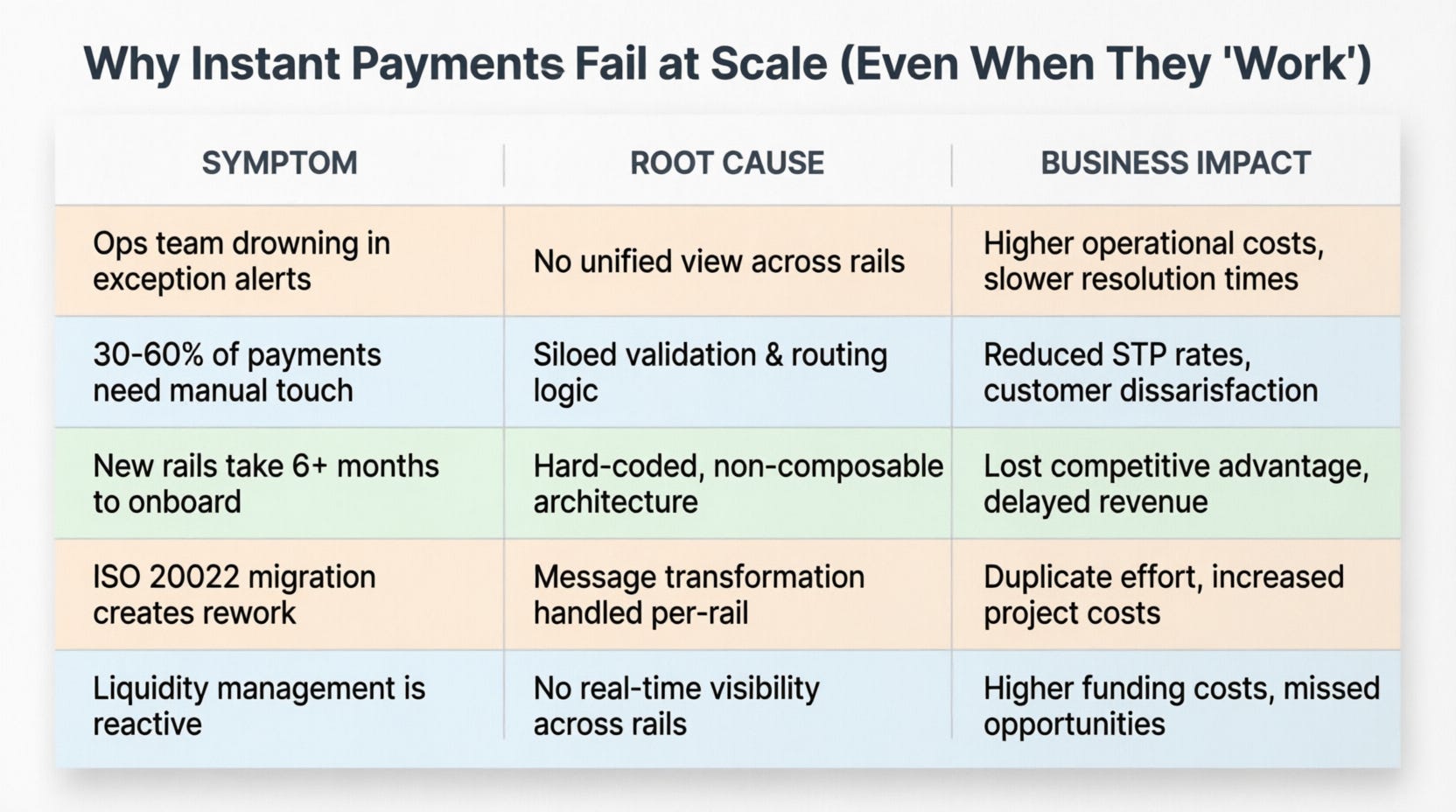
The pattern? Banks are building point solutions for each payment rail—instead of creating an orchestration layer that sits above them all.
Think about it:
FedNow has its own integration
RTP has its own integration
ACH has its own legacy system
SWIFT has its own middleware
Cross-border has... another system
Your operations team now has five different dashboards to monitor. Your developers maintain five different codebases. Your compliance team audits five different systems.
This isn’t scalable. It’s not even sustainable.
What “Payment Orchestration” Actually Means (And Why It Matters)
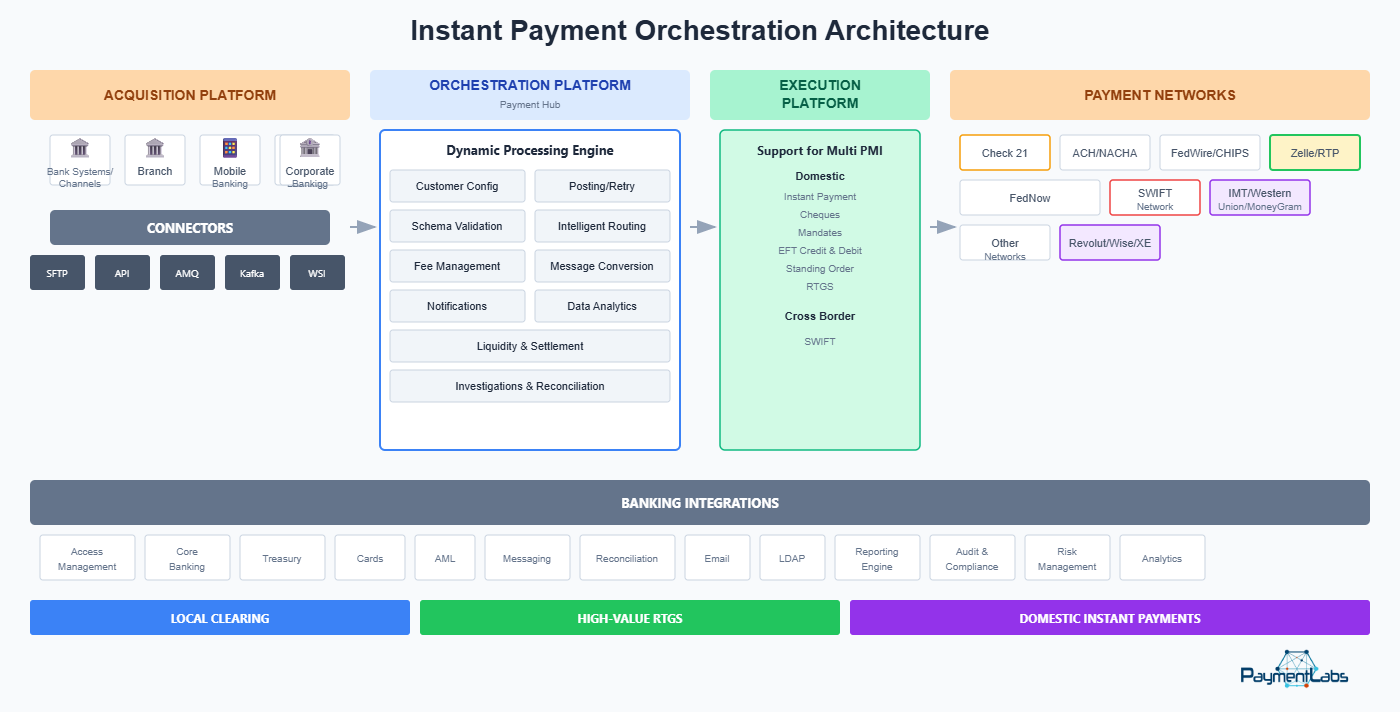
Let’s get specific. Orchestration isn’t just routing. It’s the intelligent layer that sits above payment rails and handles:
🔹 Dynamic Routing
Not all payments are created equal. A $50 consumer P2P payment has different requirements than a $500,000 corporate treasury transfer.
An orchestration engine evaluates each transaction in real-time:
Cost: Which rail is cheapest for this transaction type?
Speed: Does the customer need instant settlement, or is next-day acceptable?
Success Probability: Which rail has the highest uptime right now?
Compliance: Are there regulatory constraints for this corridor or amount?
Real example: A bank in the UAE reduced cross-border payment costs by 35% just by intelligently routing between SWIFT, Buna, and regional RTGS based on destination country and amount.
🔹 Unified Validation
Instead of validating schemas separately for FedNow, RTP, and ACH, you create one validation engine that applies consistently across all rails:
ISO 20022 schema checks
Fraud rules (velocity, amount thresholds, geolocation)
Compliance flags (OFAC, sanctions, KYC status)
Business rules (account status, limits, mandates)
Result? You write the rule once, and it applies everywhere.
🔹 Real-Time Exception Handling
Here’s where most payment systems break down:
Traditional approach:
Payment fails → Alert generated → Ops team manually investigates → Resolution takes hours or days
Orchestration approach:
Payment fails → Rule engine evaluates failure type → Auto-retry on alternate rail OR auto-escalate to specialist queue → Resolution in minutes
Case in point: A Tier-1 bank in East Africa implemented automated exception handling and reduced mean time to resolution from 4.2 hours to 18 minutes. That’s not just efficiency—that’s customer experience.
🔹 Multi-Rail Visibility
One dashboard. One source of truth. One operational team.
Whether it’s:
FedNow instant payment
RTP network transaction
ACH batch file
SWIFT cross-border message
Mobile money transfer (M-Pesa, MTN MoMo)
Real-time gross settlement (RTGS)
Your ops team sees it all in one unified interface with:
Real-time status tracking
End-to-end audit trails
Liquidity positions across rails
Exception queues with intelligent prioritization
SLA monitoring and alerts
🔹 Future-Proof Configurability
New payment rail launching in 6 months? CBDC pilot? RippleNet integration?
With orchestration, you don’t rewrite code. You configure the new rail:
Define message schemas (YAML/JSON)
Map to internal data model
Set routing rules
Configure validation logic
Deploy via CI/CD pipeline
Time to market: Weeks instead of months. Sometimes days.
Technical Foundations That Enable Real Orchestration
If you’re evaluating platforms (or building in-house), here are the non-negotiables:
✅ Event-Driven, In-Memory Architecture
Batch processing has no place in instant payments. You need:
In-memory data grids (Redis, Apache Ignite) for sub-millisecond lookups
Event streaming (Kafka, Pulsar) for real-time state changes
Stateless microservices that scale horizontally on Kubernetes
Sub-second processing even at millions of transactions per day
Why it matters: When a $2M corporate payment hits at 2:47 AM on a Sunday, your system can’t “process it in the next batch window.” It needs to validate, route, execute, and confirm—instantly.
✅ API-First, Microservices Design
Monolithic payment hubs are dead. You need:
RESTful APIs for every function (routing, validation, execution)
Composable workflows that can be rearranged without code changes
Service mesh architecture for resilience and observability
Loose coupling so you can swap components without breaking everything
Real-world impact: A bank wanted to add real-time fraud scoring to their payment flow. With microservices, they injected a new service into the workflow via configuration—zero code changes to existing components.
✅ Low-Code Configurability
Your business analysts should be able to:
Adjust routing rules without waiting for dev sprints
Create new payment products via drag-and-drop
Modify validation logic through visual editors
Deploy changes through CI/CD pipelines
The alternative? Every rule change requires:
Business requirement doc
Dev team sprint planning
Code changes
QA testing
UAT signoff
Production deployment
That’s 4-6 weeks for a rule change. With low-code, it’s 4-6 hours.
✅ Cloud-Agnostic Deployment
Regulatory requirements vary by country. You need flexibility:
On-premises for data residency requirements
Public cloud (AWS, Azure, GCP) for scalability
Hybrid for workload distribution
Multi-tenant for shared services across subsidiaries
Key point: The same codebase should run anywhere without modification.
✅ Built-In Observability
You can’t manage what you can’t measure. Essential capabilities:
Distributed tracing across microservices
Real-time dashboards for ops teams
Automated alerting based on SLA thresholds
Audit trails for compliance and forensics
Liquidity reporting updated in real-time
Performance analytics to identify bottlenecks
The Business Outcome: What You Actually Gain
Let’s talk numbers. Banks that implement proper orchestration see:
⏱️ 60% Faster Time-to-Market
Launch new payment products in weeks, not months
Onboard new rails with configuration, not code
Test and deploy via automated pipelines
Example: A regional bank launched FedNow + RTP + Zelle integration in 14 weeks—simultaneously. Traditional approach would have taken 9-12 months per rail.
💰 30-50% Lower Processing Costs
Automation reduces manual intervention
Intelligent routing minimizes transaction fees
Consolidated infrastructure eliminates redundant systems
Cloud-native architecture optimizes resource utilization
Real case: A Middle East bank reduced payment operations headcount by 40% through automation—while processing 3x the transaction volume.
🛡️ 100% STP Potential
Proactive exception management
Automated retry logic
Intelligent fallback routing
Real-time validation
Benchmark: Top-performing banks achieve 95%+ STP rates on instant payments. Laggards hover around 60%.
🌍 One Platform for Domestic + Cross-Border
Unified operations team
Consistent customer experience
Simplified compliance and reporting
Easier expansion into new markets
Strategic advantage: When a bank in Kenya wanted to expand into Tanzania and Uganda, they replicated their payment hub in weeks—same codebase, localized configurations.
📈 Operational Clarity
One team, one dashboard, one source of truth
Reduced training time for new staff
Faster onboarding of acquisitions
Better work-life balance for ops teams (no more 3 AM fire drills)
“We didn’t just add a rail. We rebuilt how payments flow.”
— CTO, Tier-1 Regional Bank (post-orchestration rollout)
Case Studies: Orchestration in Action
Case 1: Largest UAE Bank – AANI Instant Payments
Challenge: Launch UAE’s instant payment scheme (AANI) while maintaining existing RTGS, ICCS, and cross-border operations.
Solution: Implemented orchestration layer with:
Dynamic routing between AANI, UAEFTS, and SWIFT
Unified exception handling across all rails
Real-time liquidity management dashboard
Results:
4 million transactions/month processed
100% straight-through processing
9 peripheral systems integrated seamlessly
4th-degree exception handling (auto-resolve → auto-retry → specialist queue → escalation)
Recognized by Central Bank and MEA Finance Awards
Case 2: Largest East African Bank – Multi-Country Payment Hub
Challenge: Consolidate payment operations across Kenya, Uganda, Tanzania, and Rwanda—each with different clearing systems, regulations, and mobile money providers.
Solution: Deployed multi-tenant orchestration platform supporting:
Kenya: KEPSS, M-Pesa, CTS, ACH
Uganda: UCH, RTGS, MTN MoMo, Airtel Money
Tanzania: TISS (low/high value), Vodacom M-Pesa
Rwanda: RIPPS (ACH/RTGS), MTN MoMo
Cross-border: SWIFT, PAPSS, regional EAPS
Results:
10 trillion KES lifetime value processed
80% reduction in inward transaction processing times
Multi-tenant SACCO and corporate clearing established
Single operational team managing all four countries
100% STP across all rails
What to Do Next (If You’re Serious About Instant Payments)
Ready to move beyond “checkbox compliance” to real payment transformation? Here’s your roadmap:
1. Audit Your Current Payment Ops
Ask the hard questions:
Where do exceptions pile up? (Be specific—which queues, which rails?)
Which payments require manual intervention? Why?
How long does it take to launch a new payment product?
What’s your current STP rate by rail?
How many different systems does your ops team use daily?
Pro tip: Shadow your operations team for a day. You’ll learn more in 8 hours than in 8 weeks of reports.
2. Define Your Orchestration Requirements
Must-haves vs. nice-to-haves:
Non-negotiable:
Multi-rail support (current + future)
Real-time processing (sub-second)
Event-driven architecture
API-first design
Cloud-agnostic deployment
Low-code configurability
Unified operational dashboard
Differentiators:
AI/ML-powered routing optimization
Predictive exception handling
Real-time liquidity forecasting
Embedded compliance (RegTech integration)
Customer-facing payment tracking portal
3. Start Small, Think Composable
Don’t boil the ocean. Pilot one workflow:
Good starting points:
FedNow exception handling automation
RTP intelligent routing
Cross-border payment tracking
Real-time liquidity reporting
Success criteria:
Measurable STP improvement
Reduced mean time to resolution
Positive ROI within 6 months
Scalable to other rails
4. Measure What Matters
Stop tracking “go-live date.” Start measuring:
STP Rate: % of payments requiring zero manual touch
Mean Time to Resolution: How fast do you fix exceptions?
Cost per Transaction: Fully loaded (infrastructure + ops + fees)
Customer Satisfaction: NPS for payment experience
Time to Market: Weeks to launch new products/rails
System Uptime: 24/7 availability percentage
Liquidity Efficiency: Reduction in idle balances
The Competitive Reality
Here’s the uncomfortable truth:
Your competitors aren’t waiting.
Neobanks are launching instant payment products in weeks
Big Tech (Apple, Google, Amazon) is embedding payments into every experience
Fintechs are partnering with community banks to offer enterprise-grade capabilities
Central banks are pushing real-time infrastructure as public utility
The question isn’t “Should we modernize?”
It’s “How fast can we move before we lose relevance?”
Final Thought
Instant payments aren’t about moving money faster.
They’re about moving intelligence faster.
The banks that win won’t be the ones with the most rails connected.
They’ll be the ones with the smartest layer managing those rails.
Orchestration isn’t optional anymore.
It’s the foundation of payment competitiveness in 2026 and beyond.
Let’s Start the Conversation
If you’re exploring payment orchestration—or just want to sanity-check your roadmap—hit reply. I’m happy to share:
What’s working (and what’s breaking) in real implementations
Vendor evaluation frameworks (if you’re not building in-house)
Architecture patterns from banks that got this right
Common pitfalls to avoid (we’ve seen them all)
No pitch. No sales deck. Just practical insights from the front lines of payment transformation.
Because the future of payments isn’t coming—it’s already here.
The question is: Are you orchestrating it, or just reacting to it?
I’m Akhil Rao, CEO of Payment Labs and Element Six— a global payments technology and consulting firm operating across the Middle East, Europe, Africa, and Asia. I contribute to SWIFT CGI, ASC X9, the Bank of England’s CHAPS Data Committee, and other industry groups working on payments modernisation. My work has been published by the BIS, HM Treasury, the Federal Reserve, and the Bank of England.
© Akhil Rao · Payments Intelligence Brief · Subscribe · paymentlabs.ai